Sample Pro Pack
Elephant printable lesson pack
This public sample shows the real printable quality before a buyer chooses Pro.
SizeRef Pro Pack
Elephant
This comprehensive pack provides engaging, age-appropriate activities to teach children about elephants, their size, and unique characteristics.
Learning Goals
- Identify an elephant and its main body parts.
- Learn descriptive words for an elephant.
- Understand the large size of an elephant using familiar comparisons.
- Practice English vocabulary and sentence structure related to elephants.
Teacher / Parent Setup
Print all pages. Gather crayons, pencils, and a ruler. Prepare pictures or videos of elephants if possible to enhance visual learning.
Curiosity Focus
Why do elephants have trunks?
This pack includes a reviewed diagram poster and a Kids Ask Why page that turns curiosity into a short explanation and mini activity.

Page 2
Vocabulary Builder
Little Explorer's Elephant Fun
Elephant
Trace the word 'elephant' with your finger or a crayon.
Look at the elephant picture. What do you see? Point to its trunk! Point to its big ears!
Pretend to be an elephant. Swing your arm like a trunk. Take big, slow steps around the room.
Elephant Facts and Words
An elephant is a very big animal.
It has a long trunk to drink water and pick up food.
Elephants have large ears and thick, strong legs.
Write two sentences about what an elephant eats or does.
Word bank: elephant · trunk · ears · big · water · land
Understanding Elephant Intelligence
Elephants are known for their incredible memory, which is a key part of their cognition. They can remember water sources, food locations, and even other elephants or humans for many years. This strong memory helps them survive in their environment, especially during dry seasons when finding water is crucial. Their social structures are complex, and memory plays a vital role in recognizing family members and maintaini...
Why is a good memory so important for an animal like an elephant that lives in the wild?
Page 3
Size Science Lab
Read the size clue
An adult elephant is truly enormous! Its width is about 6500 millimeters, which is 6.5 meters. Imagine a school bus; an elephant is as long as that bus! Its height is around 3300 millimeters, or 3.3 meters. This means it's taller than the ceiling in most houses, and you would need to stack three average-sized adults on top of each other to reach its height. The elephant's depth is 2500 millimeters, or 2.5 meters, making it quite wide too. These gentle giants are the largest land animals, weighing as much as a small...
Quick Check
How many meters long is an elephant?
Estimate
If an elephant is 3.3 meters tall, about how many children standing on each other's shoulders would it take to reach its height?
Name two things that are smaller than an elephant and two things that are bigger than an elephant.
Page 4
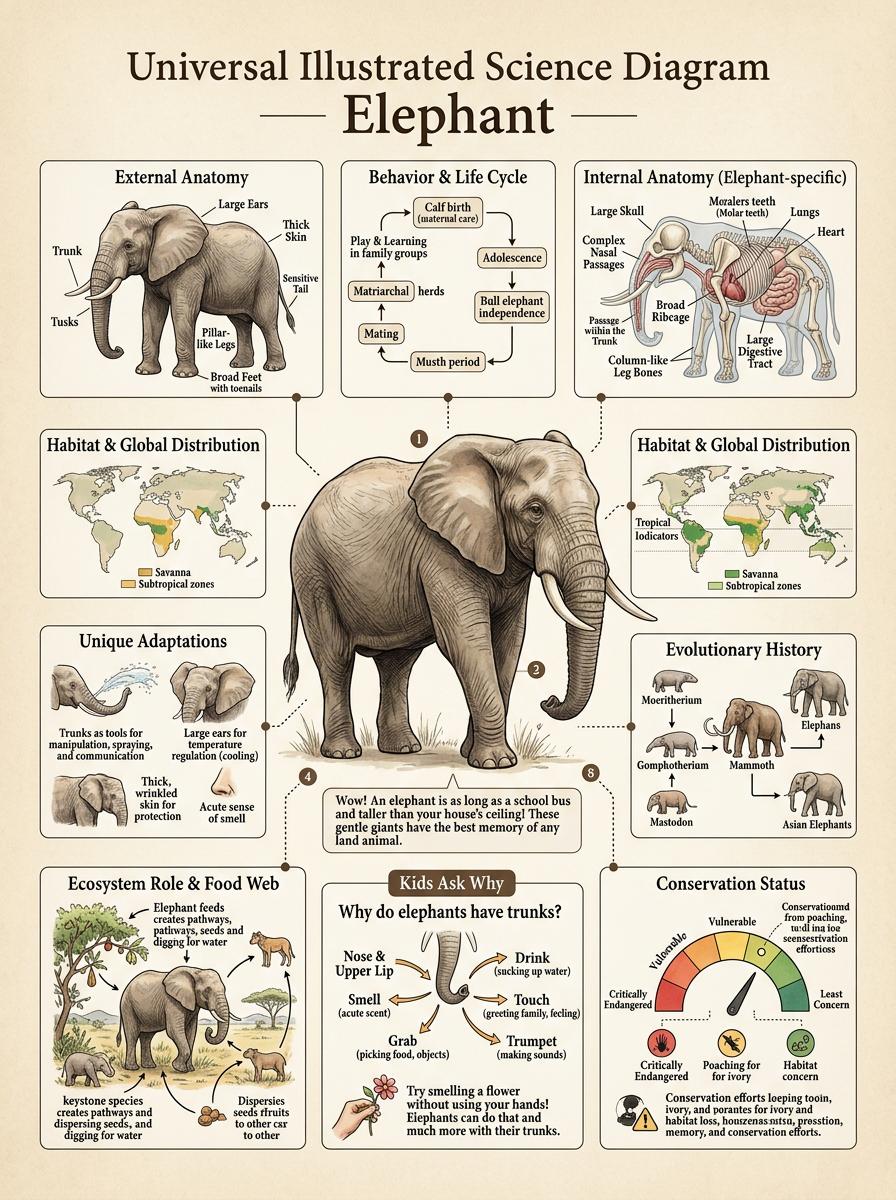
Scientific Diagram Poster
Reviewed diagram
Elephant Scientific Diagram with Kids Ask Why
Batch reviewed generated diagram for Pro Pack use. Check labels, Kids Ask Why panel, anatomy/context modules, and print readability.
2026-06-11
Page 5
Kids Ask Why Lab
Big Question
Why do elephants have trunks?
An elephant trunk is both a nose and an upper lip. It helps the elephant smell, breathe, drink, grab food, touch family members, and make sounds.
How to diagram it
Split the trunk into labeled functions: smell, drink, grab, touch, and trumpet.
Cause-and-effect arrows
1-minute activity
Use one hand as a pretend trunk to pick up a soft object, then discuss why a flexible tool is useful.
I noticed:
My answer in one sentence:
Draw your own explanation
Page 6
Comprehension + Drawing
1. What is special about an elephant's memory?
2. What do elephants use their trunks for?
3. Where do elephants live?
4. Is an elephant a small or a big animal?
Draw and compare
Draw an elephant. Now, draw a small car next to it to show how big the elephant is.
Page 7
Answer Key + Teaching Notes
Answer Key
- Elephants have the best memory of any land animal.
- They use their trunks to drink water, breathe, and pick things up.
- Elephants live in Africa and Asia.
- An elephant is a very big animal.
- 6.5 meters long.
Teaching Notes
- Encourage learners to use descriptive words when talking about the elephant.
- Use visual aids like pictures or videos of elephants to enhance understanding.
- Adapt activities for different learning styles (visual, auditory, kinesthetic).
- Emphasize the 'gentle giant' aspect to promote respect for animals.
- Discuss why conservation of elephants is important for our planet.
Extension Activity
Research different types of elephants (African vs. Asian) and their habitats, noting key differences.
Unlock the full Pro library
This ready-to-use pack provides structured, engaging content across multiple age groups, eliminating hours of lesson planning.